


Every year for the past several years, the same prediction circulates: This is the year the IPO market comes back. We said it in 2025. We said it in 2026. We’ll probably say it again in 2027.
And every year, a handful of headline-grabbing offerings get held up as proof. This cycle it’s SpaceX, OpenAI and Anthropic. The narrative writes itself: the window is open, the giants are listing, the market is back.
But here’s the catch: those aren’t IPOs for the rest of the market. They’re exceptions to a rule that has been hardening for 30 years.
The IPO market isn’t closed. It’s shrinking.

The instinct is to treat the IPO drought as cyclical, a consequence of rate hikes, market volatility or investor risk appetite. Fix the macro, the thinking goes, and the listings follow.
The data doesn’t support that story.
In 1996, more than 8,000 companies were listed on U.S. stock exchanges. Today, fewer than 4,000 are, even as the U.S. economy has tripled in size.
The bar to go public has moved in one direction.
In 1980, the median company went public with around $64 million in revenue in today’s dollars. Today, the typical IPO candidate has revenue that would have made it a mid-cap public company a generation ago.
The result: Companies are staying private far longer, and the liquidity that shareholders were counting on keeps getting pushed out.
Every time the IPO window “reopens,” it reopens at a higher threshold than before. Waiting for conditions to return to historical norms isn’t a strategy. It’s a bet against a structural trend that has outlasted every rate cycle, bull market and recovery in recent memory.
The companies left behind
When the bar rises high enough, it doesn’t just delay IPOs. It eliminates them.
There are thousands of private companies in the United States today with $50 million, $100 million, $200 million in annual revenue, with continued growth. Previously, companies at that scale formed the backbone of the public markets. Today they’re still private, and most will stay that way.
Not all of them are great businesses. Some raised at 2021 peak valuations and are quietly running out of runway. But a real subset has grown past the early venture stage. They have revenue, margins and years of operating history. The IPO was supposed to be the exit. For most of them, it won’t be.
Who’s actually suffering
Employees at these companies made a bet: below-market salaries, equity instead of cash, years of building. Their equity was supposed to be liquid by now. It isn’t. Meanwhile, life has continued: mortgages, children, aging parents, career crossroads.
I lived this at Groupon. When I left, exercising my options triggered a tax bill I couldn’t afford without finding liquidity for shares I didn’t know how to sell. The market for these shares exists in theory. In practice it’s opaque, fragmented and slow. A transaction that should take weeks can take months, if it closes at all.
Venture general partners are in a different bind. Their funds are locked in companies with no exit path. Distributed to Paid-In capital is near historic lows. Limited partners who expected returns from prior vintage funds are still waiting, either holding back re-commitments or concentrating capital into the megafunds that can generate deal flow regardless of exit conditions. The mid-tier manager without DPI is struggling to raise.
A small number of the most prominent companies can run tender offers, giving employees a company-sponsored, structured opportunity to sell their shares.
For everyone else, there are brokered secondary marketplaces that work, slowly and imperfectly, for a narrow slice of the most in-demand names. According to Caplight, 90% of all venture secondary volume was concentrated in just 15 companies last quarter. For the rest, the market barely functions.
We’ve been here before
This situation has a historical parallel most people in finance have forgotten.
In the late 1800s, the New York Stock Exchange was the only legitimate listing venue, and it was selective. Hundreds of real companies couldn’t meet the requirements, so brokers took matters into their own hands. They gathered on Broad Street, outside the NYSE, and began trading unlisted stocks on the curb. Literally on the sidewalk. It was chaotic, informal, fragmented. No centralized pricing. No standardized process. No real infrastructure.
But the companies were real. And the demand was real.
Over time, the curb traders organized. They moved indoors. They built rules and infrastructure. The Curb Market became the American Stock Exchange. The companies that traded there weren’t defective, the system was.
The private secondary market today looks a lot like that sidewalk. Fragmented brokers. Inconsistent pricing. Transactions that depend on who you know. The companies being traded are real. The demand is real. The infrastructure doesn’t exist yet, but it’s coming. Markets that serve real economic needs don’t stay informal forever.
The original Curb Market didn’t fail. It grew up. What’s happening in private secondaries today will do the same. The only variable is timing, and the shareholders waiting on liquidity are the ones absorbing the cost of that delay.
Shawn Bercuson is the founder of Earlyasset and managing partner of Earlyasset Capital, where he is building infrastructure for and investing in the venture secondary market. Earlier in his career, he was part of the original founding team at Groupon.
Related Crunchbase query:
Related reading:
- The IPO Window Won’t Stay Open On Its Own
- Forecast: 2024 Was Slow For Tech IPOs, But 2025 Could Be Different
- Crunchbase Predicts: IPOs Picked Up In 2025 And The Outlook For 2026 Is Even More Optimistic
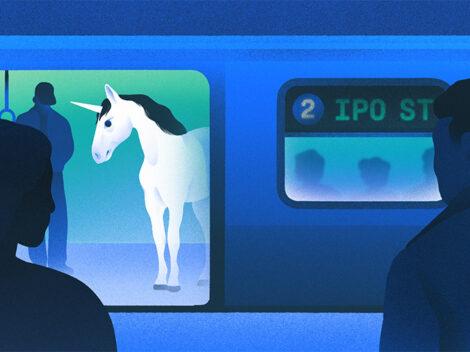
Illustration: Dom Guzman

Stay up to date with recent funding rounds, acquisitions, and more with the Crunchbase Daily.
![Illustration of a guy watering plants with a blocked hose - Global [Dom Guzman]](https://news.crunchbase.com/wp-content/uploads/quarterly-global-3-300x168.jpg)

67.1K Followers